


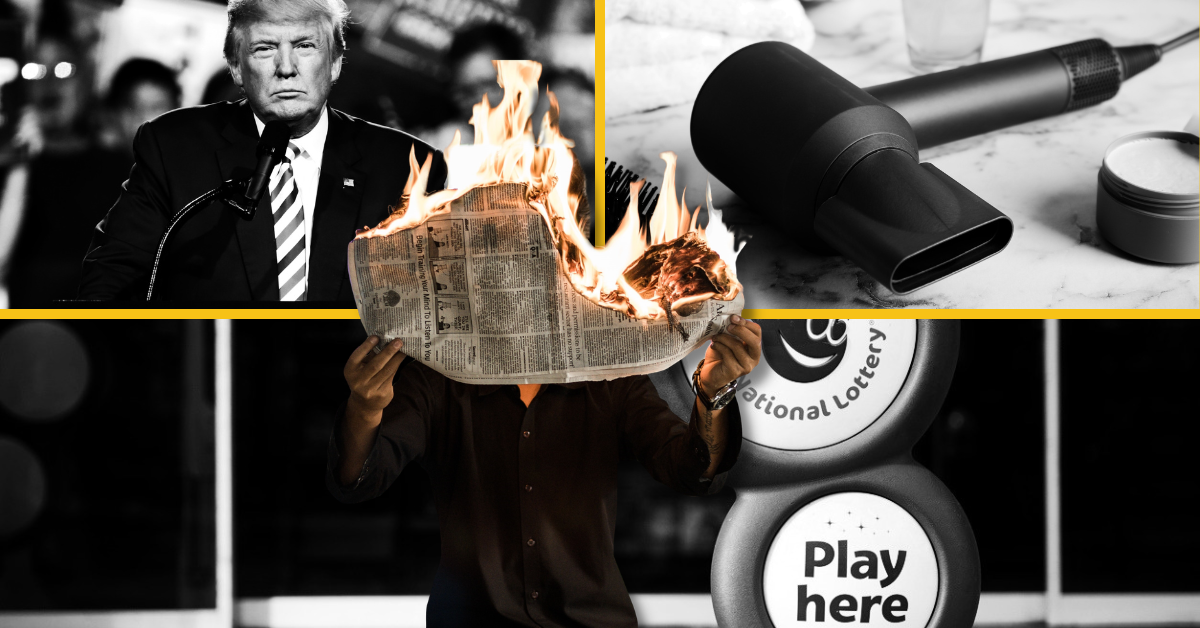
Trump card
Shortly before Donald Trump said he was ‘never much in favour’ of prediction markets this week, a BBC News investigation outlined a suspicious pattern that feels tailor-made for the conspiracy corner of the internet.
According to the report, there have been repeated spikes in financial market activity shortly before major announcements made by the president, sometimes just minutes ahead of the news going public.
We’re not talking about vague market murmurs either. These were sharp, well-timed bursts of trading that appeared to anticipate market-moving statements, raising the obvious question of whether some traders had access to information before the rest of the world caught up.
Huge trades on oil prices shortly before announcements regarding the war in Iran, and the now-infamous trades before the capture of Venezuelan President Nicolás Maduro were cited as examples of uncanny precision from traders.
The BBC stops short of making direct accusations, but the pattern is clear enough to prompt scrutiny. Experts cited in the piece note that while markets often move on expectations, consistently getting the jump on major announcements is another matter entirely.
For gambling industry readers, there’s a familiar echo here. The dynamics aren’t a million miles from betting markets reacting to “inside info”, except in this case, the stakes are global financial markets rather than match odds or transfer rumours.
And, as ever, proving wrongdoing is the hard part. Suspicious timing alone doesn’t equal insider trading, but it does tend to attract attention, particularly when the trades cluster so neatly around headline moments.
How’s the weather?
Speaking of market manipulation, French police are now investigating claims that a humble hairdryer may have been used to tamper with a temperature sensor at Paris’s Charles de Gaulle airport, potentially helping Polymarket traders land a tidy payday.
According to The Telegraph, temperature readings at the airport spiked unexpectedly on two separate days this month, jumping from a steady 18C to late surges of 21C and 22C. Crucially, those spikes came late in the day, well after markets had priced in far lower peak temperatures.
That created a near-perfect setup. On both occasions, prediction market odds had placed the higher temperature outcomes at less than 1%, meaning anyone backing them stood to make outsized returns. And someone, it seems, did: one trader reportedly pocketed $21,000 on a single position, while total winnings linked to the events hit around $34,000.
The data source? A publicly accessible weather station, which now finds itself at the centre of suspicion. France’s official weather agency, Météo-France, has filed a complaint after identifying “physical findings” suggesting interference with one of its sensors.
As for the method, online sleuths have floated a low-tech solution: a battery-powered hairdryer aimed at the thermometer. A crude system, but, if true, undeniably effective.
There is no confirmation yet that any manipulation took place, and no indication that winnings will be clawed back. But the episode highlights a familiar vulnerability: when real-world data feeds betting markets, even small points of failure can have outsized consequences.
It seems that in prediction markets, “edge” can sometimes come from the least sophisticated tools imaginable.
Luckiest man alive
Finally, some lighter news. In a story that reads like statistical fiction, The Guardian profiles a Welsh man who has won £1m on the lottery not once, but twice, despite odds estimated at more than 24 trillion to one.
The first win came in 2018, discovered mid-shift while he was working in his hair salon. A routine ticket check turned into confusion at the till, then disbelief, and finally confirmation: £1m richer. Immediately afterwards, the winner went back to finishing a client’s hair because, well, life goes on.
Unlike the usual “quit everything” narrative, he didn’t. He kept working, stayed local, and took a measured approach to spending, buying his home, helping family, and even picking up a minibus for the local rugby club.
Crucially, he also kept playing, holding the same supernatural belief in his ‘lucky’ numbers. And then, against all the odds, years later it happened again.
The second win landed via an app notification early one morning, initially dismissed as a half-asleep misunderstanding. It wasn’t. Another £1m win was confirmed, in another stroke of coincidence, by the same helpline operator who’d taken the first call.
Even then, the winner’s response stayed grounded. He carried on working (this time as a delivery driver), shared the money with his children, and upgraded to a “dream house,” but resisted any dramatic lifestyle overhaul.
The story serves as a neat reminder of the enduring power of narrative in games of pure chance. The maths may be astronomical, but stories like this are what keep the dream alive.
Because even though it’s already happened once, it can always happen again.

