



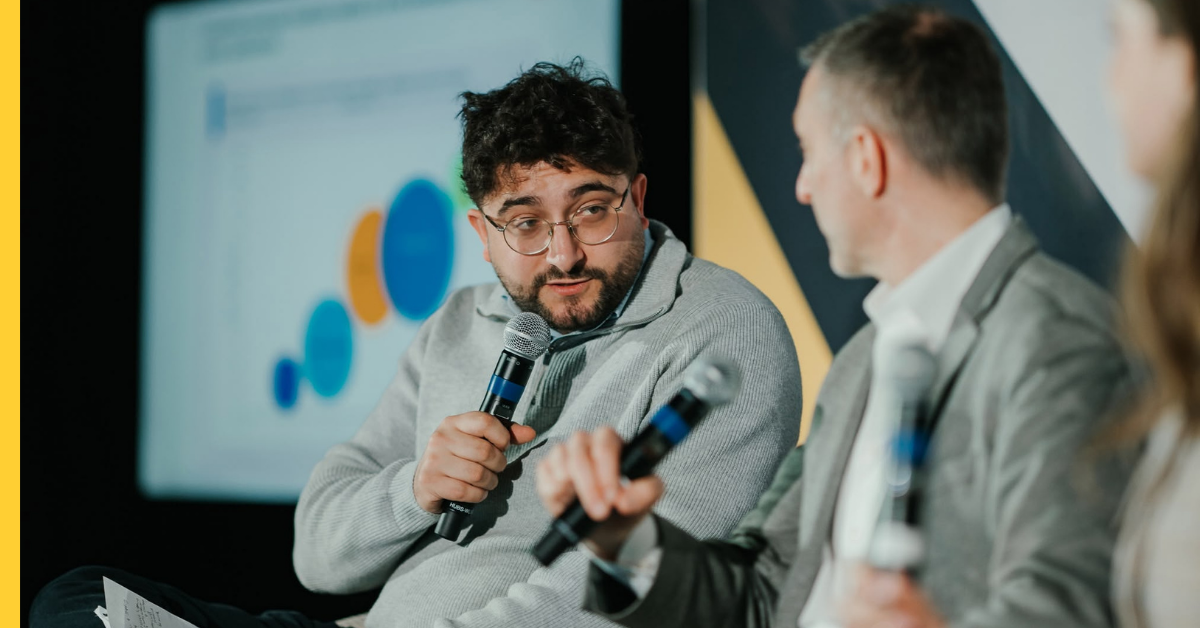
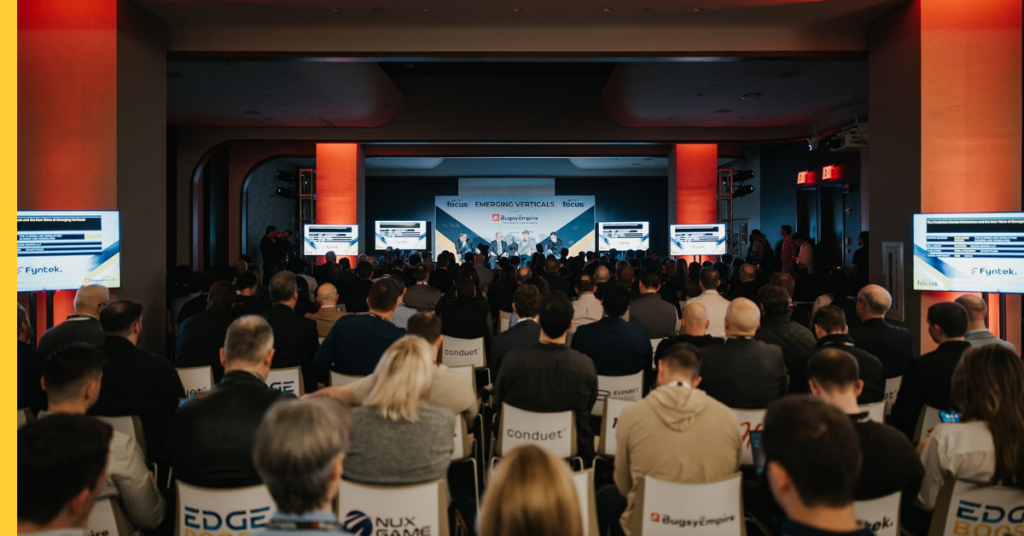
After a week on the ground at NEXT Summit New York, NEXT.io journalist Zak Thomas-Akoo has bought a first-class ticket aboard the prediction markets hype train.
It’s Kalshi’s world and we’re just living in it.
At the NEXT Summit New York last week, situated at the beating heart of the global economy in lower Manhattan, you could be forgiven for forgetting about the existing US gambling industry.
During one early panel on regulatory progress, you could practically hear the audience groan when the conversation switched to the prospect of further state-by-state iGaming legalisation – it’s not going to happen guys!
For the suits who run the sector, and especially among the various hangers-on and shovel salesmen, prediction markets mania is here. Whether you are the type to make snarky comments about how these same people were into sweeps 12 months ago, or to dive into the hype head-first with goggles and an exchange betting pitch, you can’t deny that things are happening (and quickly).
Like any gold rush, there will probably be a dozen hapless bums for every lucky so-and-so who strikes it big – but even that doesn’t mean we can’t have fun along the way.
Funny money
The build up to the show was marked by reports that prediction market frontrunners Kalshi and Polymarket were seeking loony tunes valuations of $20bn at their latest fundraise. As one investment guy remarked to me this week, this is “funny money”.
As Kalshi and Polymarket execs hung out in Miami at a serious sounding financial conference (because they’re not gambling companies, of course), their possible acquisition targets didn’t get a chance to strut their stuff in-person in New York. However, the chatter from the trade show is that PM-focused M&A deals are absolutely in the pipeline.
Low quality front-ends have been highlighted as a major problem, with some in New York suggesting an acquisition of Novig and its top tier team and product would be the perfect tonic. Coincidence or not, the Jacob Fortinsky-led operation has just completed its own chunky $75m Series B round at a $500m valuation, and has applied with the CFTC to become a Designated Contract Market (DCM) – a mechanism which is fast becoming effectively a federal sports betting licence.
Speaking of which, DCMs were being flogged to anyone and everyone on the conference floor, but these may have a short shelf-life. As the example of Railbird shows, the best time to apply for approval for one of these was 2022, as DraftKings may end up paying $250m for the exchange.
One source predicted more recently federally-licensed exchanges might go for $10m-$20m, with new applicants possibly worth a fraction of that. Time is everything in this game, and interested parties will be weighing up whether it is worth paying the cash to skip the queue, or better to do it themselves and risk losing momentum.
This scramble for approval is one of the clearest ways the prediction markets free-for-all has mirrored the post-2018 OSB rush, beyond just the matched colour schemes of some major players. Businesses anxious to buy a DCM might do well to remember how much a Pennsylvania market access deal used to cost.
‘How do I short this?’
These mega valuations for top-tier prediction markets are essentially best-case scenarios. There’s every reason to think that sports-event contracts won’t last the decade. At a relatively stable 75% of volume, according to an illuminating Bank of America panel, it’s hard to imagine the companies could justify these nine-figure totals without them (although the PMs themselves would say the real opportunity is beyond sports). As such, the nuts and bolts of the legal and regulatory battles to come will mark the boundaries of just how much money can be made in this space.
On the regulatory side, many of those in the know at the conference hinted that CFTC rulemaking was imminent, and were proved right after public comment dropped on the Thursday.
Whether a framework devised by CTFC chair Michael Selig and his Trump-appeasing team can survive a President Gavin Newsom is questionable, and Don Jr.’s appointment as an adviser by the big two (Kalshi and Polymarket) may add to the left’s sense that this is all just one big grift by the Trump family, and one more wrong to put right somewhere between normalising relations with Canada and knocking down that ballroom.
This of course won’t be helped by inevitable attempts (it is only a matter of time) to launch an online casino-style prediction markets product, which may be where the line is eventually drawn. “How do I short this?” one exec joked to me, before admitting they were also exploring ways of make a fistful of prediction markets cash before the music stops.
But even in the unlikely scenario that prediction markets don’t become a polarised political issue, there’s also the tribes to consider. Although fresh off something of a victory against the sweeps, they are now similarly concerned by PMs. On one panel, both the California and Oklahoma tribal gaming leaders James Siva and Matthew Morgan called prediction markets the greatest ever existential threat to tribal gaming in its history.
A lobbying war is coming, and the tribes have already been knocking on doors in Washington DC. One legal source claimed the tribes haven’t played their hand perfectly, so far at least. However, prediction markets will still have a mighty opponent here, one that has only recently shown its potential to sink new verticals.
*shrugs*
Meanwhile, connoisseurs of US legal battles will no doubt be enjoying the baffling variety of prediction market cases throughout the country. This season has even had some comic moments (one fan favourite saw prediction markets claim geofencing their platforms from tribal reservations was technically infeasible).
Another panel featuring an august line up of the industry’s best legal minds essentially shrugged its shoulders and said ‘who knows’ when asked to adjudicate on the legal outcome for prediction markets. Andrew Kim said he’d be lazing in a pool after cashing in Kalshi’s cheque, if only he knew.
In terms of whether the case will go to the Supreme Court, the answer appears to be a resounding ‘probably’, as the appeal courts will likely end up having split rulings, with the biggest showdown of all set for something like 2028-29.
Prediction markets are increasingly seeping into the national conversation, and the big two will need to solve some of their more obvious PR failures if they are to survive a public and media backlash. Polymarket found itself at the centre of a public row this month regarding the minor ethical issues involved in allowing government insiders to profit off a nuclear-first strike, which probably wasn’t helpful on this front. That is just one example of many, and there will be plenty more to come.
For all the hindsight-driven analysis over the industry’s fleeting dalliance with sweeps last year, the truth is that prediction markets are simply a much bigger deal. But like sports betting before it, there is good reason to think the pool of eventual winners will be small.
According to Bank of America, 93% of all US regulated prediction markets liquidity goes through Kalshi alone, with Polymarket meanwhile cleaning up outside the US. The serious challenger to those two is Robinhood. This liquidity issue means prediction markets could end up with an even more top-heavy ecosystem than OSB’s DraftKings-FanDuel duopoly. Then again, perhaps not. Maybe the digital natives at major betting operators will prove more resilient than the land-based dinosaurs they stole the online opportunity from.
But I can’t shake the feeling that those who will really make out like bandits are the handful of major players and a supporting cast of companies that manage to get their M&A over the line now. Who remembers Penn spending $2bn to buy theScore?
But you know what? It might be the jetlag talking, but I’m kind of into prediction markets now. As grating as some of the PMs’ Uber-reinventing-buses energy can be, no one can deny this is a black swan event that has upended the game board. Who knows how it will all pan out, but dare I say, it’s actually quite fun?

