


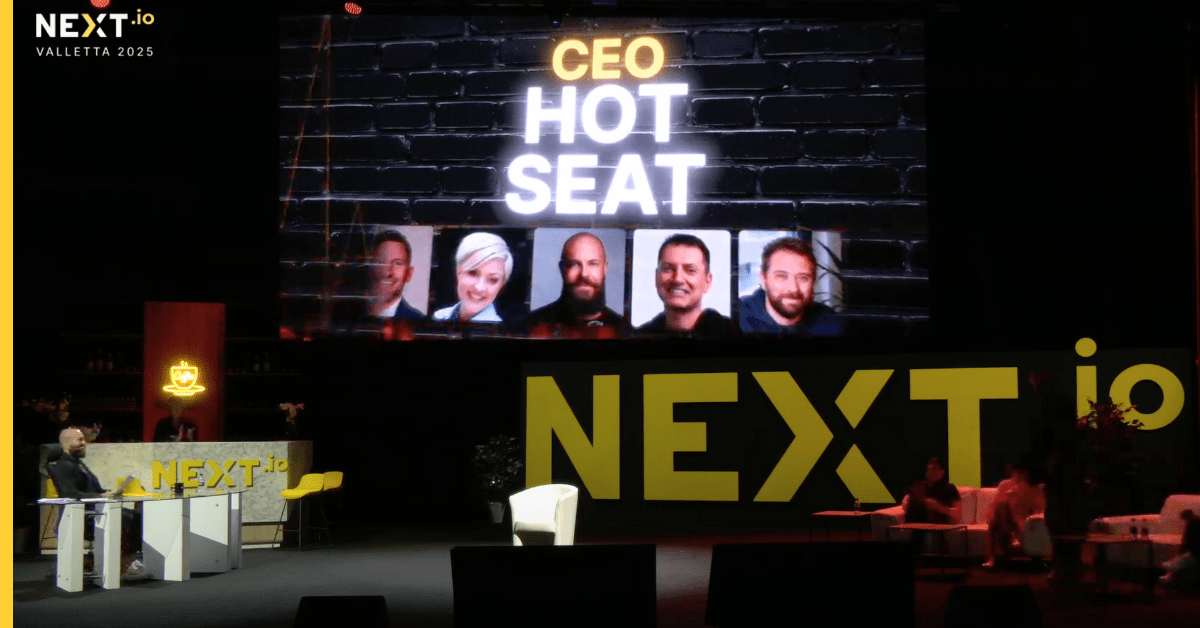
At NEXT Summit Valletta, four industry leaders took the stage to share revealing insights on leadership, identity, and the toughest calls they’ve ever made.
Sam Sadi on social phobia…
LiveScore Group CEO Sam Sadi was the first to take the hot seat, and moderator and Pressenter Group CEO Lahcene Merzoug didn’t hold back:
“Sam, you actually skipped the intro call and sent your PR guy instead, which left us all wondering, Is he busy? Is he mysterious, or is he just next level brand management?”
“I suspect it’s because the PR team is worried about what I would say. So they try to prevent me from appearing as much as possible, because I’m very opinionated, and I can sometimes get in trouble with my answers,” Sadi replied.
Merzoug noted Sadi’s calmness on stage and asked what still makes him nervous. “Every day when I try to convince my C-suite about what needs to be done, when I need to convince my board that we need to invest in a particular area, and I know for a fact that they completely disagree,” Sadi said.
…and boardroom battles
Sadi admitted he sometimes has to make tough calls alone. “There’s been an instance very recently where most of my board and C-suite disagreed with the decision, but they also couldn’t agree on what else to do. So sometimes you just have to make the call,” he said.
Asked about black market operators, Sadi admitted: “Well, we have to address it without being hypocrites. Many of us have been labeled as offshore black market operators at sometime in our careers.
“If we’ve been in this business long enough, when there was no regulation, we were all supposedly illegal operators, and we lobbied for regulation.”
While Sadi appeared composed on stage, he revealed that behind that calm exterior is someone who’s battled with social phobia for most of his life.
“Well, I mean, I’m on this panel, so it may not make sense to people, but I’m an extreme introvert. I had had to deal with social phobia most of my life.
“So the fact that I can stay here and my heart rate doesn’t go up to 200 is because I’ve trained for this. This is certainly not something I’m comfortable with.”
Kelly Kehn on being the “diversity police”…
Next up was Kelly Kehn, co-founder of Defy the Odds and co-founder of the All-In Diversity Project, who didn’t hold back when discussing the state of diversity in gaming.
Merzoug asked her about early versions of the ICE trade show featuring scantily clad women on the event floor — a trend many now view as outdated.
“Well, listen, that event kind of made me some sort of diversity police because we were the only ones talking about it,” Kehn said.
While she acknowledged that things have improved, she made it clear there’s still work to be done.
“We’re still using people as objects, which I think is not good. I think we can be smarter than that. It still happens, although it’s happening less.”
Asked which of today’s major gaming events is doing the worst on this front, Kehn didn’t hesitate: “Sigma.”
…and her no asshole policy
Turning to her current work in start-up investing, Merzoug asked Kehn what common beliefs about success or growth she often helps her clients unlearn — and what mindset she tries to instill instead.
“We only have one value, and that’s no assholes,” Kehn said. “That means a lot to a lot of people, but it covers a lot of things. So obviously, no assholes — but it also means being open, being humble, being willing to learn, and having principles.”
As someone who’s closely tracked diversity trends in the sector, Kehn was also asked which companies are falling behind. Though initially reluctant to name names, Merzoug pressed her for specifics.
“I would say evoke, sorry,” she said. “Some of the overhaul that I’ve seen has gone back to early 90s or late 90s type look and feel of their board and C-suite, and you can see that in their numbers a little bit.”
Phil Pearson on hiring from outside…
White Label Casinos CEO Phil Pearson weighed in on everything from black market definitions to the role of women in leadership.
Merzoug opened with a hot-button issue: “In just a few words, how would you differentiate between a grey, a dark grey, and a black market?”
Pearson broke it down with his trademark directness: “There’s different ways of doing grey. You see people following white market principles, following RG, KYC… There are loopholes that you can use, as long as you follow them. That is one way I would look at doing kind of light grey.
“But then you get onto the darker grey — the crypto sites who do some KYC — and then you have completely unlicensed, who I would just heavily avoid.”
Asked what portion of his platform’s revenue comes from these murky segments, Pearson was quick to clarify: “I’d say 100% light grey, to be honest.”
“We are doing all we can,” he said, adding: “I’ve only ever seen DraftKings who can actually actively track a VPN. No one else really manages.”
On diversity, Pearson’s company boasts that 66% of leadership roles at his company are held by women. Merzoug posed a provocative question: Given how male-dominated the talent pool is in gaming, could this indicate discrimination against men?
Pearson didn’t flinch. “The thing I found is that a lot of people who’ve been in gaming for a long time — no offence to the 800 people sat there — do come with some issues. There’s a lot of laid-back attitudes that you might not always need.
“So we do try and hire outside of gaming, and generally, from what we found, women tend to interview better. We have a mixed hiring team — always four different people, two men and two women — and we just literally hire based on merit.”
…and fighting Sweden
Finally, when asked to name one seemingly insane decision that turned out to be brilliant, Pearson recounted a stand-off with the Swedish government:
“I had a fight with the Swedish government… against our legal counsel’s advice, I decided that it is okay to do MGA traffic still in Sweden after they said no. So I did it, and then Sweden blacklisted us.
“I called them up and said, ‘You’re wrong,’ and explained why. After a three-week discussion — where my boss and chief legal officer both said, ‘You’re insane, you shouldn’t work here anymore’ — I won.
“They issued an apology, and we were the only legal MGA site in Sweden for eight months.”
Alex Pratt on banning Russia…
Alex Pratt, group managing director at Clarion Gaming, may have led some of the most influential gaming events in the world — but stepping onto the big stage was still a first.
“On a scale from 1 to 10, how nervous are you?” Merzoug asked.
“Probably 9.8. Yeah, terrified,” Pratt admitted. “For a long, long time, I’ve been terrified of public speaking… I even 10 or 15 years ago went to a hypnotist. But I thought, if you’re not pushing yourself, if you’re not out of your comfort zone, how are you going to develop?”
One area where Pratt hasn’t hesitated to take a stand is Clarion’s decision to block Russian and Belarusian-owned businesses from exhibiting at ICE.
“That was a decision we took just before ICE 2023… It wasn’t a political decision,” he said. “We spoke to our customers, we spoke to the industry, and we found it was the right thing for the industry, the right thing for our customers, and the right thing for our company.”
The policy is still in effect, with Clarion continuing to run UBO checks to enforce it.
Asked whether similar action would be taken against companies from other conflict-involved nations, such as Saudi Arabia or Turkey, Pratt acknowledged the complexity.
“There is no blueprint for this… We’ll continue to reflect the values of our business and how we go about doing business, and make a decision based on that. Will it make everyone happy? Probably not.”
…and owning past mistakes
Merzoug also asked Pratt whether he had ever mistreated someone and regretted it. Pratt shared a story dating back to 2007/2008.
“I was young, ambitious, aggressive, and I wanted to own the world. I didn’t understand that monopolies aren’t necessarily good things.
“We had one competitor left in Amsterdam called Casino Affiliate Convention (CAP).
“In my infinite wisdom,” Pratt said, he hired the bar opposite their venue and branded the whole thing — affiliates drink free — from 11am to late night.
“It was incredible. Loads of people came. When I look back, it was an asshole thing to do,” Pratt admitted.
“I still believe we need to be ambitious, we need to be aggressive, but there’s ethical ways of doing it.”

