




There has been confusion this week over which government department controls gambling in Curaçao following conflicting media reports. NEXT.io investigates.
Antilliaans Dagblad reported on Sunday (12 October) that the entire Supervisory Board of the Curaçao Gaming Authority (CGA), which oversees a large chunk of the planet’s overall offshore gambling, had resigned in mid-September.
The newspaper appears to have learned about the board resignations by reviewing the Chamber of Commerce’s trade registry, as opposed to any official communication from the government.
It further stated that Prime Minister Gilmar Pisas, who was re-elected in March, had effectively taken over the portfolio.
The resignations took place around the same time as a corruption scandal for Finance Minister Javier Silvania, who had previously been responsible for overseeing gambling.
Following on from the report, several other local papers and specialist gaming news sites repeated the claim that Prime Minister Pisas had assumed oversight of the sector.
In support of the claim, some outlets highlighted Pisas’ 12 September meeting with the CGA’s board, days before the resignations, in which he discussed a variety of regulatory topics — with the government making no mention of any organisational change.
However, the CGA strongly rejected the claims that Pisas is now in charge of gambling in a statement published yesterday, with consultant Aideen Shortt — who has been leading point on communications with the gaming industry — slamming “sensationalist headlines and fake-news articles” about the matter.
Highlighting a 19 August document which contained an order redistributing government portfolio, the CGA clarified it was now nested under the Ministry of Justice and its minister Shalten Hato, not the PM’s Office as previously reported.
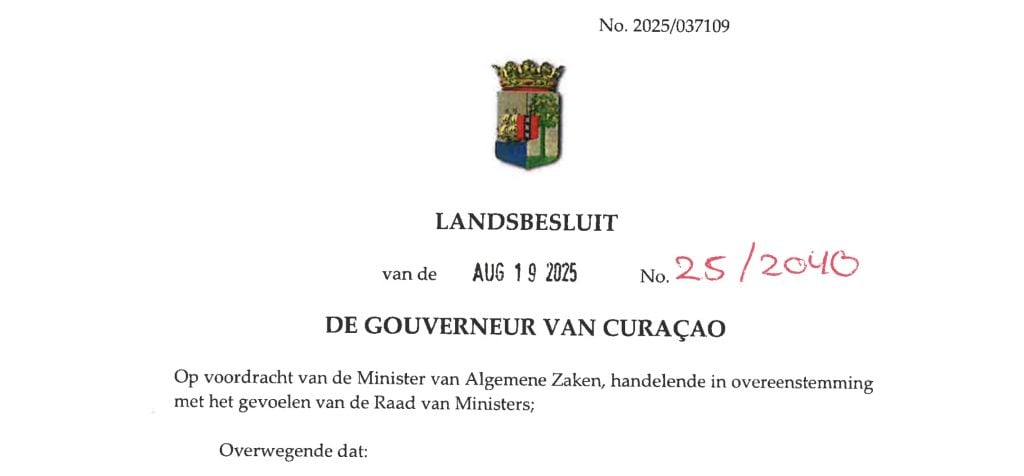
The move was made, the document says, since the focus of the government is shifting toward supervision, compliance, and the fight against illegal activities, which the Ministry of Justice is better equipped to deal with.
As such the board resignations, which some outlets had obliquely linked to Silvania’s corruption allegations, were said to have been a standard procedural step given the change in the portfolio, and the regulator said it was currently in the process of appointing new members.
The CGA said: “This development does not affect the performance of the CGA’s supervisory duties, including the continued implementation of the National Ordinance on Gaming (LOK). All licensing and supervisory activities will continue uninterrupted.
“The Curaçao Gaming Authority remains committed to ensuring an honest and reliable gaming sector in Curaçao.”
Government criticised over lack of transparency
In an article published yesterday, Antilliaans Dagblad acknowledged its headline “Gaming now under Pisas” was inaccurate but criticised the government’s failure to provide timely information.
The newspaper said: “The media indeed have a major responsibility in communication, but that responsibility also lies with the government, which should provide proactive and timely information. That did not happen in this case.
“Only after this newspaper revealed that CGA no longer falls under the Minister of Finance did the Council of Ministers and CGA itself — two months after the fact — provide the necessary information. The government has a ‘duty to provide information’; that is part of true transparency.”
It should be noted the Minister of Finance had played a prominent role in liaising directly with the gambling industry during the reform process, often travelling abroad as part of this work.
Alongside the lack of communication about the change from official channels, sources also told NEXT.io the 19 August document which moved gaming oversight to the Justice Ministry was never actually published in the online government gazette which tracks official updates.
NEXT.io can find no trace of it in the gazette archives, with the last government announcement regarding portfolio changes occurring in July and still listing gaming under the Ministry of Finance’s remit.
Additionally, Antilliaans Dagblad said the changes were not reported in Cabinet Minutes.
NEXT.io understands there was a lawsuit filed last year, currently out for appeal, which questioned the legality of the gambling portfolio being nested within the Ministry of Finance.
This, the lawsuit argued, was because gambling should legally be considered an export and therefore be overseen by the Netherlands, since the country is ultimately responsible for Curaçao’s foreign policy.
Given how controversial the island’s online gambling regime has been with some of its critics, the poor communication around important governance changes has been harshly criticised.
Antilliaans Dagblad also suggested that the underlying political reasons behind the changes remain obscure.
It wrote: “The big why (the question of the real reasons) remains unanswered: did something go wrong (a misstep by Silvania); is it happening under pressure from The Hague; or is an (internal political) power struggle underway?”

