Economic forecasting isn’t just for Wall Street insiders anymore. Thanks to economy prediction markets, you can now trade event contracts based on what is actually happening in the real world.
Whether you want to back your theories on the next Federal Reserve interest rate move, shifting inflation numbers, or the latest employment reports, platforms like Kalshi and Polymarket let you turn your macro insights into tradable assets. This guide will help you navigate these markets on top platforms, read market probabilities, and more.
At a basic level, economic prediction markets are simple to navigate. You predict whether a specific macroeconomic event will occur, buy a position, and collect a payout if your prediction is correct.
Economic prediction markets use binary contracts tied directly to real-world indicators like inflation, GDP, or central bank policies. Every single contract in these markets operates on a “Yes/No” basis, trading between 1¢ and 99¢, and settling at exactly $1.00 if correct or $0.00 if incorrect.
A Real-World Example: Next Fed Rate Hike
Instead of simple two-outcome markets, major economic timeline events often feature multiple tiered brackets. Consider the current market tracking the timing of the next Federal Reserve rate hike on Kalshi:
Before 2027:
Yes: 58¢ | No: 43¢
Before July 2027:
Yes: 72¢ | No: 30¢
Before 2028:
Yes: 81¢ | No: 20¢
The contract prices directly reflect the market’s real-time implied probability of each specific temporal window.
How Your Trade Resolves
Traders take positions based on where they think the market’s collective economic consensus is wrong:
Buying “Yes”:
If you believe macroeconomic pressures or persistent inflation will force the central bank to hike rates sooner than expected, you can buy “Before 2027” for 58¢. If the Fed increases rates at any point before the end of 2026, your contract resolves to Yes, settling at $1.00 for a 42¢ profit per contract.
Buying “No”:If you are convinced that economic headwinds or a cooling labor market will delay any tightening cycles past the end of the year, you can buy the “No” contract on the Before 2027 option for 43¢. If no hike occurs before 2027, your contract resolves to No, settling at $1.00 for a 57¢ profit per contract.
To guarantee absolute transparency, regulated platforms rely exclusively on objective, primary source data from official government agencies and global financial authorities. Interest rate contracts resolve using official central bank statements and daily effective funds data.
Similarly, markets tracking inflation, employment, or GDP metrics tie their settlement rules directly to scheduled, verified data releases from institutions like the U.S. Bureau of Labor Statistics (BLS) or the Bureau of Economic Analysis (BEA). These official government reports serve as the binding source of truth, ensuring automated, accurate, and predictable contract settlement.
Best Prediction Markets for Trading the Economy
Fed decisions, inflation prints, and jobs reports move faster than almost any other category in prediction markets. Here’s how Crypto.com, Kalshi, Polymarket, Robinhood, and MooMoo each handle economic event contracts, from the granularity of individual CPI strikes to how easily the category fits into an app you already use.
Crypto.com
Level-Up Rewards available
Welcome offer for standard trading
Predict future prices for crypto
Choose yes/no contract positions
Complex for newcomers
Economic contracts on Crypto.com are built on the same CFTC-regulated infrastructure the platform uses for its broader Prediction Trading feature. Markets react to unemployment data, CPI releases, interest rate announcements, and other policy shifts, with prices adjusting quickly whenever a report surprises to the upside or downside.
Traders can use Market or Limit Orders and hold positions up to a defined per-event limit, so managing size on high-volume releases like a Fed decision stays straightforward.
Because the same account funds crypto and prediction positions, a trader tracking macro data doesn’t need to switch platforms to also hold economic exposure. That consolidation is Crypto.com’s clearest advantage for economy-focused traders.
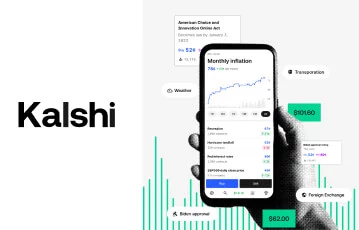
Kalshi
Accessible across the US
Simple to use
Explore niche and mainstream markets
Integrated prediction tools
Limited ongoing bonus offers
The Economics hub on this platform is built for traders who want precision, not just direction. Beyond broad Fed and inflation categories, it breaks markets into GDP, Growth, Housing, Jobs & Economy, Oil and Energy, and Global Central Banks, letting traders target the exact release that moves their theories.
Contracts on CPI, core PCE, and the federal funds rate exist at a level of granularity most exchanges don’t offer, and researchers affiliated with the Federal Reserve have published findings showing Kalshi’s intraday pricing responds to new economic data faster than, and sometimes as accurately as, traditional forecasting tools. With trending and frequency sorting, traders can see which economic release is drawing the most volume in real time.
Polymarket
Excellent trading coverage
Powerful mobile app
Speedy deposits and withdrawals
Peer-to-peer exchange
Watertight security provisions
Steep learning curve
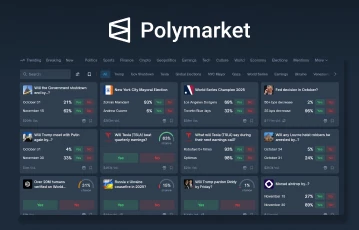
Polymarket’s Economy category is organized around the releases that actually move markets: Fed Rates, Macro Indicators, Global Rates, and Inflation each have dedicated pages with live probability percentages and volume.
A market like the Fed’s July rate decision shows continuously updated pricing as new data lands, while a broader macro dashboard pulls Fed rate hikes, recession odds, and GDP growth questions into one view.
Each contract publishes its resolution source directly on the market page, so traders know exactly what triggers settlement before they open a position.
For traders who want a single screen tracking the biggest macro questions of the year, Polymarket’s dashboard-style layout is a genuine convenience.
Robinhood
Diverse range of markets
Rules are easy to understand
Excellent, user-friendly apps
No contract centric promotions
Robinhood’s Economics section pulls some of the platform’s highest-volume contracts, including Fed rate decisions, the number of rate cuts expected in a given year, and whether a recession occurs before year-end.
A market like the Fed’s July decision has drawn millions of dollars in volume with pricing that shifts as new data lands.
Contracts are offered through Robinhood Derivatives as a registered Futures Commission Merchant, positioning them as regulated financial instruments. For traders who already hold a brokerage account, adding macro exposure requires no extra setup.
MooMoo
Major prediction market categories
Several customer support channels
Licensed to offer event contracts
No crypto funding
MooMoo’s economic event contracts, launched through its Kalshi partnership, span a specific and well-defined list: Fed decisions, GDP, growth, jobs and the economy, inflation, oil and energy, global central banks, and housing.
That breakdown mirrors how professional macro traders actually think about the category, rather than lumping every data release into a single generic bucket. Contracts are fully collateralized and settled under CFTC oversight, with pricing between one and ninety-nine cents reflecting the market’s live probability.
Because the feature sits inside MooMoo’s existing brokerage app, a trader already watching earnings or Fed commentary can add a macro contract without leaving their portfolio view.
Odds & Probabilities
Another way that economic predictions differ from traditional wagering is when it comes to the odds. That’s because at most sportsbooks, the odds are set by the house based on its own analytics and calculations of the outcome coming to pass. Prediction market sites like Kalshi work differently.
With contracts, these odds are interpreted more as probabilities that are displayed as percentages – along with the price at which you can buy the “Yes” or “No” positions. These percentages are influenced by the market and trading volume, rather than the house’s own analysis.
Is This Better or Worse Than Traditional Sportsbook Odds?
There are advantages and disadvantages to both. The good thing is that the percentage you’re seeing on an economics prediction exchange is closer to the real probability. As these sites don’t profit from your predictions directly and don’t set the odds, they don’t add a “Vig” or commission to the price.
On the other hand, there are a lot more variables, including trading volume, market activity, and other factors that can cause the price to change quickly.
Economic Prediction Market Probability Example
The price of a contract doubles as the market’s probability estimate. A Yes price of $0.23 means traders are collectively pricing roughly a 23% chance of that outcome, while the matching No price of $0.77 reflects the opposite.
As new data or headlines shift sentiment, both prices move in real time to keep tracking the crowd’s current view. Payouts scale with however many shares you hold, not with a fixed odds multiplier. Buy 100 Yes shares at $0.23 each and your total cost is $23. If the event resolves Yes, each share pays out $1, for $100 total and a $77 profit.
If the price moves against you before settlement, you’re not locked in either, you can sell your shares early to another trader instead of waiting for resolution.
Is Early Cashout an Option with Economy Prediction Markets?
Yes, you can exit economy prediction market positions early by selling your shares to other users before final settlement. Unlike traditional sportsbook cashout features controlled by a bookmaker, prediction platforms operate as peer-to-peer exchanges where pricing is driven entirely by open-market supply and demand.
To secure profits early or mitigate potential losses, you must find another trader willing to buy your active contracts. This structural difference means that execution is not always instantaneous. High-volume economic markets offer rapid, fair-value exits, whereas low-volume niche markets suffer from liquidity constraints that can trap your capital or force a discounted sale.
What Economic Prediction Markets Are There?
Economic prediction markets let you put your money where your mouth is on the news that actually moves the world. Instead of just watching the headlines, you can trade on the outcomes of high-stakes events like interest rate hikes, inflation reports, and the sudden price swings of global commodities or crypto.
These platforms turn massive, complex financial shifts into straightforward contracts, giving you a chance to profit from your read on the global economy before the final data even hits the wire. Below, we’ve provided a few examples of economic prediction markets that are currently trending:
US gas prices this week
Number of rate cuts in 2026?
How high will inflation get this year?
More tech layoffs in 2026 than in 2025?
Will the Fed raise rates in September 2026?
Are Economy Prediction Markets Legal in the US?
Yes, economic prediction markets are legal in the US at the federal level, but actual trading availability remains highly fragmented by state. Users on platforms like Kalshi and Polymarket buy and sell binary event contracts to trade on real-world indicators like inflation, employment data, or interest rate adjustments.
Following a Third Circuit appellate ruling in April 2026, that classified these contracts as CFTC-regulated derivatives, exchanges gained a stronger legal footing within that circuit’s jurisdiction (New Jersey, Pennsylvania, Delaware, and the Virgin Islands). Elsewhere, the picture is far less settled, courts in other circuits have ruled the opposite way, including a New York federal judge who sided with state regulators over Kalshi on July 8, 2026, and the question may ultimately reach the Supreme Court.
However, this federal precedent has triggered an intense jurisdictional battle. Over the last few months, state regulators in jurisdictions like Illinois, Connecticut, and Arizona have pushed back, with Illinois and Connecticut issuing cease-and-desist letters targeting sports-related contracts, while Arizona filed criminal charges against Kalshi in March 2026, as they argue that these event contracts amount to unlicensed gambling under state law. The CFTC and Department of Justice responded by suing all three states on April 2, 2026, arguing the enforcement actions unlawfully target federally regulated products.
Since then, the fight has widened considerably. Minnesota’s felony ban was blocked by a federal judge days before its August 1 start date, Michigan and Nevada both now have active injunctions forcing operators to geofence their states, Ohio and Kalshi are suing each other over a $5 million fine, Washington won a court ruling against Kalshi in July 2026, and New York’s Attorney General filed a direct lawsuit in July 2026 seeking to shut Kalshi down entirely.
Find the Best Sites for Economy Prediction Markets Here
You can find the best sites for economy prediction markets right here via the banners on our page. We only displayed CFTC-regulated prediction exchanges and trading sites that are legally available in the United States.
Moreover, they have been rated and reviewed by our experts, and are ranked in order. Therefore, you can be sure to find an updated list of the best available economy prediction markets sites that you can access right now.
How We Rate Sites for Economy Prediction Markets
As experts, here are the main criteria that we consider when rating and reviewing economy prediction sites:
Security & Regulation:
The first thing we look at is whether the platform is properly regulated by the CFTC as a Designated Contract Market (DCM), like Kalshi. Why? Because it means real oversight. Your funds are kept separate, and the platform can’t just play fast and loose behind the scenes.
Range of Markets:
A decent platform doesn’t just ask “Will there be a recession?”. We consider whether or not platforms let you trade on real economic signals like inflation, interest rates, GDP growth, and jobless claims.
Prices & Value:
Each market shows a price that reflects probability. If one platform says there’s a 60% chance of something happening and another says 65%, that gap is opportunity. The best platforms give you tighter pricing and better value.
Ease of Use:
When big economic news drops, you don’t have time to fumble around. A good platform should let you place a trade in seconds. Clean layout, fast execution, and basic tools like limit orders are essential.
Deposits & Withdrawals:
Getting money in and out should be easy. We look for platforms that support quick bank transfers or crypto options with low fees and fast withdrawals. If it’s slow or complicated, that’s a red flag for us.
Customer Support:
If you happen to run into any issues or have questions you need answers to asap, it’s important to have access to real support. Our recommended platforms actually understand how markets settle and can handle disputes without issue.
Bonuses & Perks:
Finally, we look at what you actually get back. The best platforms offer things like reduced fees, interest on your balance, or rewards for early trading.
How to Get Started with Economy Prediction Markets – Step-by-step
These days, the process of trading economic event contracts on the
best prediction sites
is now faster and more regulated than ever. Below, we break down the exact steps you need to take to get started today.
Select a Regulated Exchange:
Choose a platform based on your location and regulatory preference. We recommend Kalshi or
Polymarket prediction market
platforms.
Complete Biometric Verification:
Register your account and complete the KYC (Know Your Customer) process.
Fund Your Trading Wallet:
Link your bank account for instant ACH/Wire transfers (standard for USD exchanges) or connect a digital wallet to deposit USDC stablecoins if you are using decentralized platforms.
Analyze Economic Event Contracts:
Browse the “Macro” or “Economy” categories to find specific event contracts. Current popular markets include predicting the Consumer Price Index (CPI), Non-Farm Payroll numbers, and Federal Reserve interest rate decisions.
Select Your Position (Yes/No):
Every market is based on a binary question (e.g., “Will the Fed cut rates in June?”).If you believe the event will happen, you buy “Yes” shares. If not, you buy “No” shares.
Determine Your Trade Size:
Enter the number of shares you wish to purchase. Since each share settles at exactly $1.00 if correct, the current share price (e.g., $0.62) represents the market’s estimated probability (62%) of that outcome.
Execute the Trade:
Review the “spread” (the gap between buy and sell prices) and confirm your order. Your funds will be held until the event is settled.
Monitor or Exit Early:
You do not have to wait for the official data release. If new economic news breaks and your share price increases, you can sell your position back to the market to lock in a profit instantly. Otherwise, you can wait for the final settlement to receive $1.00 per winning share.
Summary and Conclusion on Economy Prediction Markets
In summary, economy prediction markets are all about predicting and buying a position on Yes/No outcomes, which you can then either sell or wait to be resolved. If you back a “Yes” outcome and the market resolves that way, you’ll get a dollar for every share or contract you have purchased.
As this is considered financial activity in the US and not gambling, it’s not something you can find on traditional sportsbooks. Instead, you need to look towards CFTC-regulated prediction sites, the best of which you can find via the banners on this page.
Discover Our Top Choice of Economy Predictions
Economy Prediction Markets FAQ
You can access economy prediction markets through CFTC-regulated exchanges like Kalshi or Polymarket US.
The most reputable platforms for economy prediction markets are Kalshi and Polymarket. These specialized exchanges use an order-book model similar to the stock market.
Yes, economy prediction markets are legal in the United States, provided the platform is registered with the Commodity Futures Trading Commission (CFTC).
The primary difference is the outcome-based nature of the trade. In the stock market, you buy shares in a company’s future earnings. In an economic prediction market, you buy a contract on a binary event, such as “Will the Fed cut rates in June?”.
Yes, profits from prediction markets are generally considered taxable income by the IRS. Since these are financial instruments, your net gains are typically treated as capital gains or ordinary income depending on your trading volume and the platform’s specific structure.